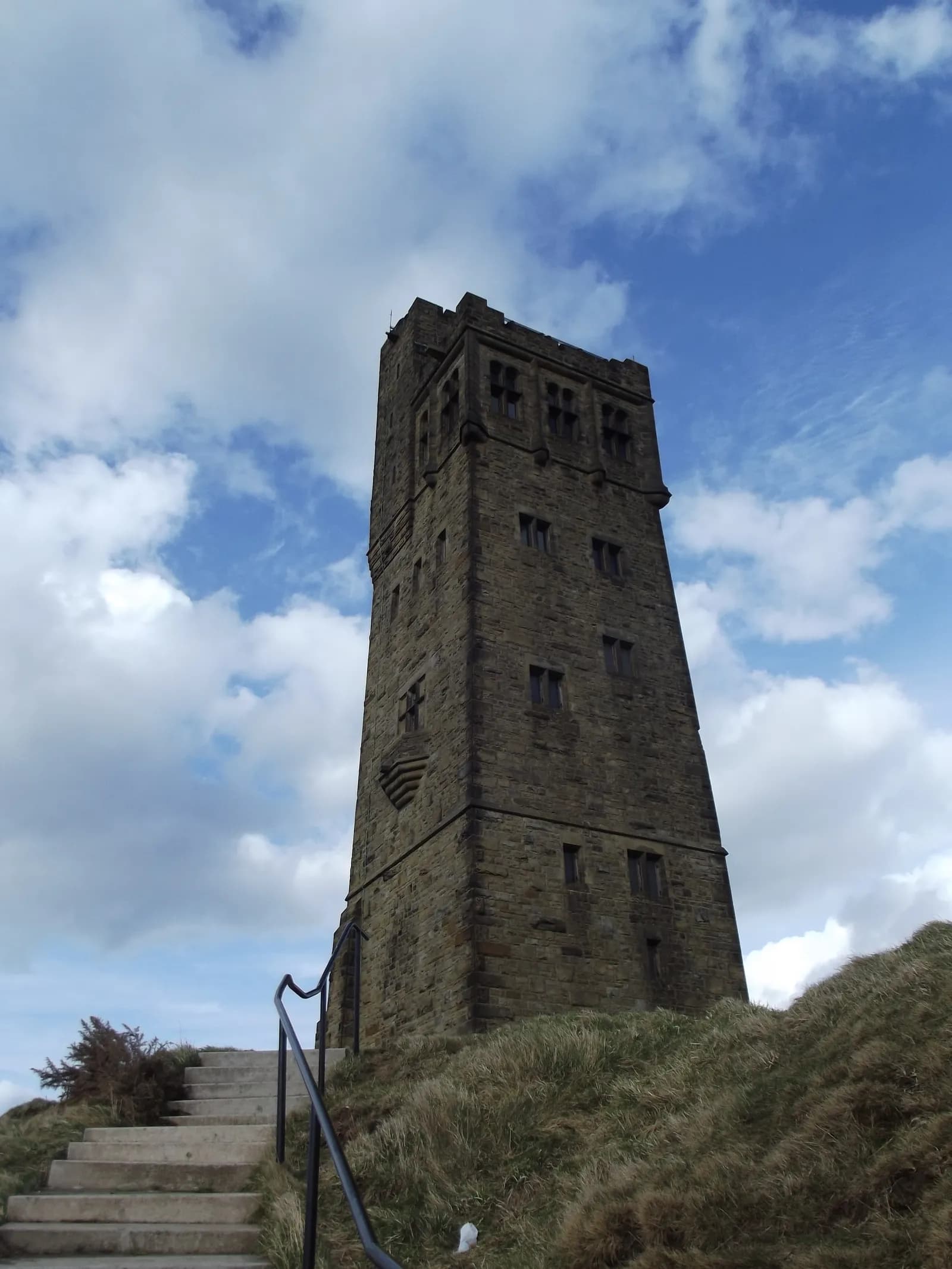
Rising above the town like a sentinel, Castle Hill stands as the most conspicuous landmark in Huddersfield. The hilltop, crowned by the Victoria Tower, has witnessed continuous human activity for at least 4,000 years, making it one of West Yorkshire's most significant archaeological sites.
From Prehistoric Camp to Iron Age Fortress
The earliest visitors to Castle Hill were Mesolithic hunter-gatherers, who established camps amongst the forests that once covered the landscape. During the Neolithic and Bronze Age periods, stone and bronze tools from distant regions were deposited here, suggesting trade routes connected the Yorkshire Wolds, Peak District, and the Mersey and Ribble estuaries through the river valleys below.
The defining feature of the hill, however, is the hillfort constructed in approximately 555 BC during the early Iron Age. Archaeological evidence reveals a complex defensive evolution; the site began as a univallate hillfort with a single raised bank, later expanded into a multivallate structure with multiple defensive banks encircling the entire hilltop. Around 43 AD, as Roman forces advanced northward, the defences were modified to meet the new threat, though the fort ultimately fell victim to a severe fire. Excavations in 1970 demonstrated that Castle Hill suffered episodes of burning so intense that the stone vitrified, a phenomenon rarely found in England and more commonly associated with Scottish hillforts.
Norman Conquest and Medieval Castle
Following the Norman Conquest of 1066, Almondbury became part of the Honour of Pontefract, held by the de Lacy family. These Norman lords established a motte-and-bailey castle on the hill, mentioned in a charter from King Stephen to Henry de Lacy dating to approximately 1142–1154. Archaeological work has provided concrete evidence of this occupation; a wooden stake radiocarbon-dated to the late 1140s and a coin from about 1160 suggest the castle was complete and occupied by the 1140s.
In the early 14th century, an attempt was made to found a settlement in the lower bailey. Aerial photography has revealed a central roadway flanked by regularly laid-out plots, though the settlement was probably abandoned by the 1340s. The memory of this vanished town lingered for centuries; a 1634 map of Almondbury still marked the hill as the site of a town. Today, the remains of this deserted medieval village form part of the scheduled ancient monument.
Beacon Fires and Working-Class Politics
After the medieval period, Castle Hill remained uninhabited until the early 19th century. Its prominent position made it ideal for a warning beacon as part of a national network. Around 1810 to 1811, a tavern was built to cater for pleasure-seekers, with a bowling green situated to the south. The hill also gained a reputation for less respectable entertainments, hosting bare-knuckled prize fights, dogfights, and cockfights.
The flat hilltop also served as a stage for political gatherings. Chartist rallies were held here at least four times in 1843 and 1848. In 1883, during the great weavers' strike, between two and three thousand people braved bitter weather to listen to speeches by union leaders. These gatherings cemented Castle Hill's place in the working-class political history of Huddersfield.
The Victoria Tower: A Jubilee Memorial
In 1897, as Queen Victoria became the longest-reigning British monarch, plans emerged for a permanent memorial. The foundation stone was laid on 25 June 1898 by J. Frecheville Ramsden, son of Sir J.W. Ramsden, the Lord of the Manor. The tower was designed by Isaac Jones of London, whose design was selected through competition, and built by Ben Graham and Sons of Folly Hall using stone from Crosland Hill.
The tower measures 20 feet square at its base and rises 100 feet to the turret flat, with a total height of 106 feet from the ground. The summit reaches approximately 1,000 feet above sea level, commanding panoramic views across the surrounding landscape. The cost was approximately £2,800 to £3,298, depending on the source. The tower was formally opened by the Earl of Scarborough on 24 June 1899. Its correct name is the Victoria Tower, though it is sometimes incorrectly referred to as the Jubilee Tower.
During construction, workmen uncovered significant archaeological remains. Castle walls were found at a depth of five feet, and at one corner of the site, they discovered a rock-cut sinking five feet square. After digging to a depth of 15 feet without reaching bottom, further excavation was abandoned. This mysterious feature, possibly a well, is now enclosed within the tower walls.
War and Preservation
During the Second World War, there were suggestions to demolish the tower to prevent its use as a navigation aid by German bombers. Several bombs were dropped near the tower in 1940 and 1941, though these were probably jettisoned at random rather than aimed at the structure. An anti-aircraft battery was built near the south-east end of the hill, and a range finder was positioned at the north side of the outer bailey. Remains of these defences are still visible today, and fragments of high-explosive shell casings occasionally surface in adjacent fields.
Castle Hill Today
Today, Castle Hill remains a popular destination for local people and tourists. In 2006, overhead electricity cables were relocated underground to enable kite users to make use of the hilltop winds. The Victoria Tower, now a Grade II listed building, continues to serve as Huddersfield's most recognisable landmark. The scheduled monument preserves remnants of all past uses; from the defensive banks of the Iron Age hillfort to the medieval castle foundations, the Victorian tower, and the remains of wartime defences.
The hill's distinctive shape results from its geology; a cap of hard Grenoside sandstone protects softer stone beneath from erosion, whilst the slopes are formed from alternating deposits of shale and harder sandstones. Five coal seams within the shales of the lower slopes were worked along the hillside by adits and shafts, with old quarries still evident on the hillside.
Castle Hill stands not merely as a viewpoint or a monument, but as a physical chronicle of four millennia of human history in this corner of West Yorkshire. From prehistoric traders to Norman lords, from Chartist agitators to Victorian commemorators, each generation has left its mark upon this enduring landmark.